How Humans Evolved: The Story of Our Species
Did you know humans evolved about 315,000 years ago in Africa? Our journey goes back millions of years. The story of human evolution is complex, filled with fossil evidence, innovations, and environmental changes.
Our closest living relatives, chimpanzees and bonobos, share a common ancestor with us. This ancestor lived around 6 to 7 million years ago. As we explore our past, we’ll look at key events and discoveries that shaped our understanding of human evolution.
We’ll see ancient stone tools found in Kenya and the remarkable Neanderthal skeleton, Shanidar 3. This story is not just about our development. It’s about our family tree and how climate and other factors helped us adapt and survive.
Key Takeaways
- Human beings evolved approximately 315,000 years ago in Africa.
- The hominin tribe includes various species like Ardipithecus and Australopithecus.
- Fossil evidence suggests that humans coexisted with Neanderthals and other hominins.
- The evolutionary relationships within the human lineage resemble a family bush, highlighting complexity.
- Stone tools and musical instruments illustrate the early innovations of our ancestors.
- Research projects and exhibits on human origins continue to enhance our understanding of anthropology.
Understanding Human Evolution
Human evolution is a complex and fascinating topic that spans millions of years. I will explore the origins of Homo sapiens and key fossil discoveries. These findings have shaped our understanding of early man and the hominin family tree.
Climate impact played a significant role in human development. Environmental changes influenced the adaptability and survival of our ancestors.
The Origins of Homo Sapiens
Homo sapiens emerged about 200,000 years ago in Africa. Archaeological finds, like the Jebel Irhoud skull, challenge old beliefs. They show the diversity within early human populations.
These discoveries help us understand how Homo sapiens evolved from earlier hominids. They adapted to their surroundings in unique ways.
Key Fossil Discoveries
Fossil discoveries are key to understanding early man’s evolution. Species like Sahelanthropus tchadensis and Australopithecus afarensis give us insights. They reveal a complex hominin family tree.
This tree shows a non-linear evolution. It highlights multiple species coexisting and interacting over millions of years.
Hominin Family Tree and Its Complexity
The hominin family tree is complex, with around 15 to 20 recognized species. This complexity shows the variety of adaptations and pressures that shaped human development. It helps us understand the paths our ancestors took.
It also sheds light on the traits that define Homo sapiens today.
The Role of Climate in Human Development
Climate impact was a big factor in human evolution. It influenced migration patterns and survival strategies. Environmental changes forced early humans to adapt.
They developed critical innovations like bipedalism around 4 million years ago. The fluctuating climate created diverse habitats for Homo sapiens. They used their cognitive abilities to navigate new challenges.
The evolution of our species shows resilience in the face of a changing world.
Milestones in the Journey of Human Evolution
Human evolution has seen many key moments. These moments show how our ancestors adapted to new environments. They highlight early human survival strategies and cultural growth.
Let’s look at the early human adaptations, major species, survival tactics, and the effects of interbreeding with other species.
Early Human Adaptations and Innovations
800,000 years ago, early humans started using fire. This was a big step forward. It helped them cook food and stay warm.
Later, around 300,000 years ago, they made better tools. These tools helped them hunt better and adapt to different places.
Major Species of Early Humans
Many important human species have existed. Homo heidelbergensis was a key ancestor around 200,000 to 700,000 years ago. It connected modern humans, Neanderthals, and Denisovans.
Neanderthals lived in cold climates. They made tools and used resources well. This shows how complex early human life was.
Survival Strategies and Cultural Development
Cultural growth was key for early humans. As they grew, they learned to hunt and gather better. They also started farming and raising animals around 10,500 years ago.
This led to living in groups and creating art. It shows how important social life was for survival. They also had a long time to raise their young, showing they cared for each other a lot.
The Impact of Interbreeding with Other Species
Interbreeding with other species made humans more diverse. Studies show we share a common ancestor with Neanderthals and Denisovans from 550,000 to 750,000 years ago.
Neanderthal genes in our DNA make us stronger. This mixing shows how early humans worked together to survive.
Conclusion
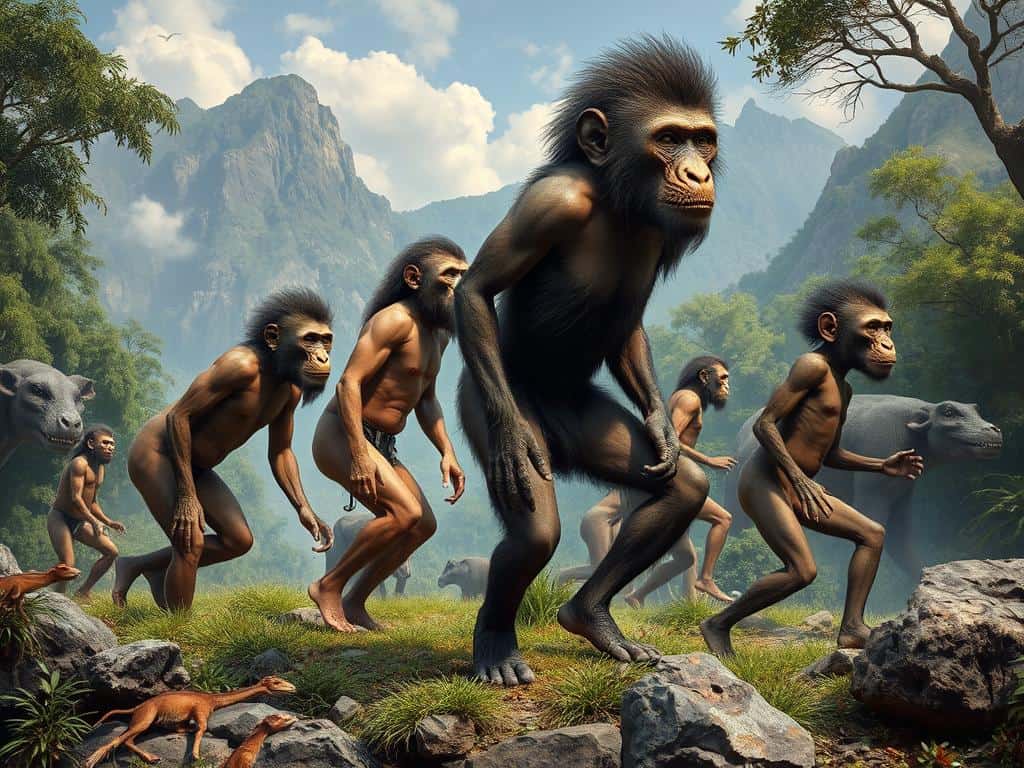
Reflecting on human evolution, we see a story of change, adaptation, and survival. Understanding evolution helps us see how our existence has been shaped over millions of years. From the early Australopithecus to the Homo genus, fossils tell us how our species has overcome challenges.
In the last century, many fossils have shown us our complex family tree. They take us from ape-like forms to modern humans. Each discovery adds to our knowledge of who we are and where we come from. These findings show us that our journey is linked to the natural world, highlighting our connection to Earth.
Exploring human origins, I’m amazed by the ongoing story. Discoveries about our ancestors’ ways of life and survival strategies deepen our understanding of evolution. They also shape our sense of identity. With each new discovery, we learn more about our resilience and our place in the world today.


How Music Has Evolved Through the Ages

How Sci-Fi Has Inspired Real-World Tech Innovations

The Greatest Mysteries Hidden Beneath the Waves
About The Author
